

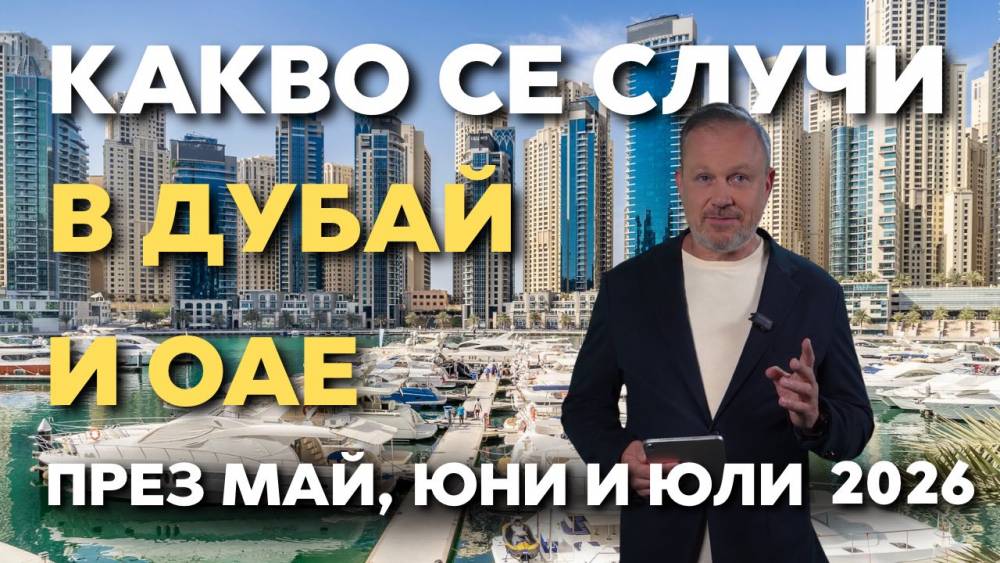
Dubai between uncertainty and major investments: what is happening with the economy and the real estate market in 2026
02.09.2026, from the Stonehard Team
- The UAE Economy: Growth Beyond Oil
- Tourism: Adaptation Instead of Retreat
- The State Supports Business with New Incentives
- Access to State Investments for Individual Investors
- What is Happening with the Real Estate Market?
- The Office Market Remains Resilient
- Dubai Stimulates First-Time Home Buyers
- Dubai Continues to Build for the Future
- Al Maktoum International Airport – Infrastructure for the Coming Decades
- New Road Corridor for 2 Billion Dirhams
- Dubai Harbour: Another Link to the Future
- What Does All This Tell Us About Dubai?
Dubai and the United Arab Emirates are going through one of the most serious periods of trial in recent years. The regional conflict is affecting aviation, tourism, shipping, trade, investments, and, of course, the real estate market.
Against this backdrop, however, one important fact stands out: the governments of Dubai and the UAE are not backing down from their long-term investment plans.
On the contrary – large-scale infrastructure projects continue, new programs for businesses are being introduced, visa opportunities are expanding, key administrative processes are being digitized, and new economic sectors are being stimulated. At the same time, the country continues to steadily reduce its dependence on oil.
It is precisely this contradiction that defines the current picture: short-term uncertainty combined with long-term investment activity.
The UAE Economy: Growth Beyond Oil
In July, the UAE announced the results for non-oil foreign trade for the first six months of 2026. The data shows significant growth.
For the period, non-oil foreign trade reached 1.937 trillion dirhams, or approximately 527 billion dollars. This represents an increase of 13.1% compared to the first half of 2025.
Particularly notable is the growth of national non-oil exports, which reached a record 452.8 billion dirhams – an increase of 23.9%.
These indicators provide important context for what is happening in the UAE economy. The country increasingly demonstrates that its economic model does not rely solely on oil but is based on trade, logistics, tourism, finance, technology, real estate, and a number of other sectors.
Nevertheless, the picture is not entirely calm.
Export orders are declining, deliveries are slowing down, transportation costs are increasing, and companies are feeling the consequences of problems around shipping and the Strait of Hormuz.
In Dubai, the PMI index remains above the 50-point threshold that separates expansion from contraction in business activity, but the production pace weakens to one of its lowest levels in years.
Tourism: Adaptation Instead of Retreat
The tourism sector also had to adapt to the new conditions, and one of Dubai's responses is the strengthening of so-called staycation campaigns – offers aimed at local residents who choose to vacation in their own country or even in their own city.
Hotels are beginning to offer more attractive conditions, aiming to stimulate domestic demand and compensate for some of the uncertainty in international travel.
For Dubai, this strategy is indicative of how the emirate responds to the changing environment: through adaptation and stimulation of domestic consumption, rather than waiting.
The State Supports Business with New Incentives
One of the most significant measures in May was the approval of a second package of economic incentives worth 1.5 billion dirhams.
It is an addition to the first package worth 1 billion dirhams, adopted at the end of March. Thus, the total value of the two packages reaches 2.5 billion dirhams.
The second package includes 33 initiatives with a duration between three and 12 months and covers various sectors, including tourism, trade and logistics, real estate, construction, education, and culture.
The message is clear: the Dubai government does not rely on the situation normalizing by itself. It actively uses public funds and policies to support business and maintain economic activity.
Access to State Investments for Individual Investors
In June, another important news appeared regarding the development of the financial market in the UAE.
The Ministry of Finance for the first time opened state Treasury Sukuk directly to ordinary citizens and residents through the Sovereign Retail T-Sukuk Programme.
The first issuance of Retail T-Sukuk was initially announced at 50 million dirhams, but due to strong demand, it was subsequently increased to 100 million dirhams.
The minimum investment is only 1,000 dirhams, which significantly expands access to a state investment instrument. The first issuance has a maturity of two years and an annual yield of 4.30%, with payments made twice a year.
This is a seemingly small change but important from the perspective of the development of the financial system: investing in government instruments is no longer reserved solely for large banks and institutional investors.
What is Happening with the Real Estate Market?
Here, too, one of the most interesting paradoxes appears.
While the mass residential market is cooling down, the luxury segment continues to set records.
In the first half of 2026, 296 homes worth over 10 million dollars each were sold in Dubai, with the total value of these deals reaching 5.1 billion dollars. This represents an increase of 14% compared to the first half of 2025.
Only in the second quarter, 131 deals for homes over 10 million dollars were made, including 26 deals worth over 25 million dollars.
These data show something very important: we cannot talk about a single real estate market in Dubai.
There are different segments – mass residential market, middle class, premium, and ultra-luxury segment – and each reacts differently to the economic and geopolitical situation.
While some buyers in the more mass segment take a wait-and-see position, demand for high-class properties continues to be supported by international investors with high purchasing power.
This division is one of the most important things to keep in mind when analyzing the market in 2026.
The Office Market Remains Resilient
According to CBRE's analysis for the second quarter of 2026, office rents in Dubai increased by about 13% year-on-year, while premium office rents grew by approximately 16%.
Occupancy is around 94%, indicating that quality office spaces continue to be in short supply.
The logistics and industrial real estate segment is also performing well. Regional uncertainty further highlights the importance of warehouse space, local stocks, and sustainable supply chains.
Dubai Stimulates First-Time Home Buyers
Alongside the investment segment, Dubai continues to stimulate real housing demand.
In June, it was announced that the First-Time Home Buyer Programme has already helped more than 3,200 residents purchase their first home in Dubai. The total value of transactions realized under the program exceeds 5 billion dirhams.
The program is available to UAE residents over 18 years old who do not own freehold property in Dubai.
In June, nine more construction and development companies joined the initiative, bringing the total number of participating developers to 22.
This shows that Dubai's strategy is not solely aimed at attracting international capital. The emirate simultaneously seeks to develop a sustainable housing market and urban environment where people live long-term.
Dubai Continues to Build for the Future
Infrastructure projects perhaps best demonstrate the emirate's long-term strategy.
In May, tunnel works began on the Dubai Metro Blue Line – a project worth over 20.5 billion dirhams.
The line will be about 30 kilometers long and will include 14 stations, with approximately half of the route underground. It will connect areas such as Dubai Creek Harbour, International City, Dubai Silicon Oasis, Academic City, and Mirdif.
The Blue Line is expected to serve about 200,000 passengers daily by 2030, with the opening planned for September 9, 2029.
For the real estate market, such projects matter far beyond transportation infrastructure.
When Dubai builds a metro, it changes the city's map.
Areas that today seem remote from the main economic centers can become significantly more accessible after the construction of new transport links. And this inevitably affects interest in land and properties near future stations.
Al Maktoum International Airport – Infrastructure for the Coming Decades
Another strategic project is Al Maktoum International Airport.
In June, the government confirmed that the first phase of the project is progressing on schedule, with the goal remaining for the airport to reach full capacity by 2032.
Work is underway on key infrastructure elements, including runways and the initial structures of terminals and gates.
This is a project of enormous strategic importance because it shows something characteristic of Dubai's development: the city does not plan only for the next two or three years but builds infrastructure with a horizon decades ahead.
New Road Corridor for 2 Billion Dirhams
In July, RTA awarded a contract worth 2 billion dirhams for the development of a new main road artery – Latifa bint Hamdan Corridor.
The project is about 12 kilometers long and includes seven bridges, eight tunnels, and new road connections between some of Dubai's existing and future transport arteries.
The corridor is expected to serve over 130,000 trips daily and about 650,000 residents and visitors.
Among the areas to be served are Nad Al Sheba, Al Barari, Dubai Hills, District One, and Mohammed Bin Rashid Gardens.
The logic here is the same: infrastructure is being built where Dubai expects the most dynamic development and population growth in the coming years.
Dubai Harbour: Another Link to the Future
In June, it was announced that the bridge to Dubai Harbour has reached 90% completion.
The project is another example of the large-scale infrastructure development continuing alongside changes in the real estate market and economic environment.
What Does All This Tell Us About Dubai?
If we look at the individual data separately, the picture seems contradictory.
The economy continues to grow, but businesses feel the consequences of regional uncertainty. The housing market is cooling, but the luxury segment is setting new records. Tourism adapts, offices remain highly sought after, and the state continues to stimulate both business and housing demand.
And against all this, Dubai continues to invest billions in metro, roads, airports, aviation infrastructure, and new urban areas.
This is perhaps the most important conclusion from developments in recent months.
Dubai is not simply trying to get through the current crisis. It continues to invest in what the city should look like in 5, 10, and 20 years.
For investors, this means that market analysis in 2026 cannot be based solely on short-term fluctuations in prices or the number of transactions.
It is much more important to understand which areas, segments, and infrastructure projects will be part of Dubai's next stage of development.
Because the current cooling may change buyer behavior but does not change the city's main direction – to develop, attract capital, people, and business, and invest aggressively in the future.
And it is precisely this difference between short-term market dynamics and long-term vision that is the key to understanding the real estate market in Dubai in 2026.
If you want to learn more on the topic, you can watch our detailed video on the subject here.
© 2016-2026 Stonehard Marketing Ltd. All rights reserved.
STONEHARD™ and the logo are registered trademarks. All text, graphics and visualization materials on the site are our property or the property of our partners, and are subject to copyright, protected by the Law of the Republic of Bulgaria and the European Union. Their use by third parties is prohibited, except with our express written consent.
This website is operated by Stonehard Marketing Ltd, a company registered in Bulgaria (EU), VAT#BG131254299.
This website aims to present and promote new property development projects under construction, as well as individual units in newly completed buildings or residential complexes offered for sale. While our partners make every effort to ensure that the information provided is accurate and up to date, certain details may change or may not be fully accurate due to the dynamic nature of the new-build property market and ongoing construction processes.
For the most reliable and current information, please refer to official email communication with our partnering local real estate agencies by submitting an enquiry via the contact forms available on each listing. Our local partner agents will provide professional consultations to clients and investors interested in purchasing units in new-build developments or newly built resale properties featured on this website.
Subscribe to our newsletter
Follow us on social networks


Our contacts:
Office address:
Realtons Place
51G Cherni Vrah Boulevard, 7th Floor
Sofia 1407, Bulgaria
Working Hours (Central European Time):
Monday–Friday: 10:00 – 18:00 (CET)
Weekends and Public Holidays: Closed
The experts at Stonehard PREMIER regularly prepare original articles and analyses related to the new construction real estate market and opportunities for profitable investments in this business segment.